
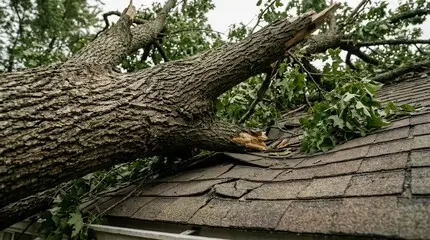
What to Do After a Tree Falls on Your Roof: A Homeowner’s Guide A fallen tree on your roof needs...

5 minute read
A fallen tree on your roof needs quick action. It is a stressful and scary situation, but do not panic. Knowing what to do in the first few hours, and understanding a few things about how the damage and the claims process actually work, can save you a lot of stress later on.
Before anything else, get everyone out of the area directly under or near the damage. A tree limb or trunk resting on a roof can shift, especially if there’s wind or additional weight from rain, and a roof that’s already been compromised isn’t a safe place to be standing under or walking on.
If you can see downed power lines anywhere near the tree, treat the whole area as dangerous and call your power company or emergency services right away rather than getting close to check it yourself.
Once the area is safe, take photos and video of everything. Get the tree itself, the point of impact, and any damage you can see from the ground or from inside the house, things like water stains, cracks, or light coming through where it shouldn’t. This documentation matters a lot once you get into the insurance claims process, and it’s much easier to capture it before any cleanup starts than to try to reconstruct it later.
From here, it’s generally a good idea to call your insurance company before you call anyone else. You can call your agent if their office is open, but your insurance company will have a toll free claims line for reporting new claims that is usually answered 24/7. Getting the claim started early means you’ll know what documentation they want, whether they need to send an adjuster out before major work happens, and what costs are eligible for reimbursement. That said, if the tree is blocking access, posing an ongoing hazard, or making it impossible to get a full look at the damage, it’s reasonable to get it removed right away rather than waiting on the adjuster. Either way, hang onto any receipts from tree removal or tarping, since those costs are often reimbursable as part of the claim.
It is not uncommon for homeowners to spend a few hours with family or neighbors cleaning up smaller parts of the tree once the big stuff is hauled off. Track how many people helped and how many hours everyone put in, and some insurance companies will reimburse you for that time.
Tree removal needs to happen before anything else can be done to the roof itself. A roofing contractor generally can’t get up there to tarp the damaged area with a tree, or even a large limb, still sitting on it, so your first call after documenting everything is usually to a tree removal company.
This is a job for professionals, not a DIY project. A tree resting on a roof can be under more tension or weight distribution than it looks, and cutting into it without knowing what you’re doing can cause it to shift suddenly. Once the tree is removed, get the area tarped and have a roofing contractor come take a look, so any further water intrusion is prevented while repairs get sorted out. Some tree removal companies will provide a tarping service for the roof. This is fine, but ask them to take good photos of the damaged areas before the tarp goes on. Having good photos available for your adjuster may prevent someone from having to remove the tarp for documentation and then reinstalling it again.
The visible damage, a hole in the roof or a crushed section of shingles, is often just part of the story. Depending on the size of the tree and the force of the impact, damage can include:
Punctures and structural damage. A large enough limb or trunk can go straight through the roof decking, not just the shingles, which affects the structural integrity of that section of the roof.
Damage to the decking and rafters underneath. Even without a full puncture, the impact can crack or weaken the wood framing that supports the roof, which isn’t always visible until someone gets up there to look.
Gutter and fascia damage. Branches often take out gutters, fascia boards, or soffit on their way down, even when the main impact point is somewhere else on the roof.
Hidden water intrusion. Once the roof’s surface is compromised, water can start working its way into the attic or interior walls well before it becomes obvious as a stain on the ceiling. This kind of damage tends to keep spreading the longer it goes unaddressed, which is part of why getting a tarp up quickly matters.
Because a lot of this isn’t visible from the ground, a full inspection from a roofing contractor is necessary to know the actual extent of the damage. Assuming it’s limited to what you can see from the yard is how hidden problems like a cracked rafter or a slow leak go unnoticed until they’ve caused a lot more damage.
This is the part that surprises a lot of homeowners. If a tree from your neighbor’s property falls onto your roof, it’s generally your homeowners insurance, not your neighbor’s, that handles the damage to your home. Most policies are written this way regardless of whose tree it was, since your homeowner’s policy covers things that happen to your house and property regardless of where the object that caused the damage originated.
It’s a good idea to loop your neighbor in regardless, both as a courtesy and because their insurance may still come into play depending on the specifics of the situation and where you live.
Call both, and pretty close to the same time. Your insurance company will want documentation and will likely send an adjuster out, but a roofing contractor can help you understand the full scope of the damage, get a tarp up to prevent it from getting worse, and provide an estimate that you can bring into the claims conversation. Having a professional’s assessment alongside your own documentation tends to make the whole process go more smoothly.
FYI, personal property like flower pots, statues, bird baths, barbeque grills, etc. are generally covered by most policies. Usually, in ground plants and trees are not, but this all depends on your specific policy language. Dig in and find out for yourself. You can request a full copy of the policy from your agent (not just the dec sheet).
If this just happened to you, the most useful thing you can do right now is get someone out to look at it before more damage sets in. At Red-tail Roofing, we can assess the damage, help you get a tarp up if needed, and walk you through what your insurance claim will usually include.
Give us a call at (816) 200-1845. We handle these situations often, and we’re happy to help you sort out what’s next.
Expand your roofing knowledge with these hand-picked insights.
What to Do After a Tree Falls on Your Roof: A Homeowner’s Guide A fallen tree on your roof needs...

Most people shop for homeowners insurance by comparing a few numbers: premium, deductible, coverage amount. Seems simple enough. But several...
When people compare metal roofs to shingles, they’re usually picturing one type of metal roof. In reality there are a...