
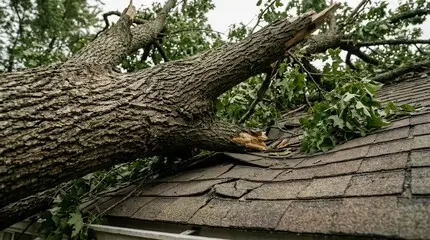
What to Do After a Tree Falls on Your Roof: A Homeowner’s Guide A fallen tree on your roof needs...

Most people shop for homeowners insurance by comparing a few numbers: premium, deductible, coverage amount. Seems simple enough. But several of the terms on that quote sheet don’t work quite the way people assume, and your roof ends up playing a much bigger role in the process than most homeowners expect. A few things below are worth knowing before you sign anything.
Insurance companies pay close attention to roof age when pricing a policy, for a pretty obvious reason: an older roof is more likely to leak or fail, so insurers treat it as more risk.
Once a roof hits somewhere around 10 to 15 years old, depending on the company and the material, your options can start to change. Some insurers won’t write a new policy on the home at all. Others will still cover it, just under different terms than they’d offer on a newer roof.
There are two main ways a homeowners policy can pay out a claim.
Replacement cost value (RCV) pays what it actually costs to repair or rebuild with similar materials at today’s prices, regardless of how old the damaged item was. The damage items will be depreciated and subtracted from your first payment from your insurance company, but will get paid out to you in a second check once you prove you have the work completed and prove you spent the money the insurance company agreed to pay. Your deductible is subtracted from their payment to you.
The deductible is like your co-pay at the doctor’s office. You pay it directly to your contractor.
Actual cash value (ACV) pays the replacement cost minus depreciation. Say your roof is 15 years old with a 30-year expected lifespan. An ACV policy might only pay out around half of what it would actually cost to replace it, since the roof has already used up roughly half its useful life.
This is where it can get a little confusing. It’s fairly common for a policy to cover the home overall under replacement cost, but shift to an actual cash value settlement specifically on the roof once it passes a certain age. So everything else in the house gets rebuilt at today’s prices, while the roof gets paid out at depreciated value instead. That gap can mean thousands of dollars out of pocket if you ever file a roof claim, which is why it’s worth asking your agent directly which one applies to your roof rather than assuming the whole policy works the same way.
Questions to ask:
1) Is there a separate deductible for wind and hail?
2) If I have a claim on the roof, is it covered at full replacement cost or actual cash value?
Most people picture a deductible as a flat number, something like $1,000 or $2,500. A lot of homeowners policies don’t work that way anymore, especially in places that see a fair amount of severe weather.
A percentage deductible is calculated off your dwelling coverage amount, not the size of the claim. If your home is insured for $300,000 and carries a 1% deductible, you’re on the hook for the first $3,000 of a qualifying claim no matter whether the total damage comes to $5,000 or $50,000. Depending on the insurer and where you live, that percentage typically falls somewhere between 1% and 5%, and it can add up to quite a bit more than a flat deductible would.
Question to ask: If I have a claim on the roof, what would my deductible be, and would it be a different deductible if I had a fire at the house or a pipe burst?
Insurers in a lot of the country, ours included here in the Midwest, apply a separate deductible just for wind and hail damage. It’s distinct from whatever deductible applies to something like fire or theft.
That wind and hail deductible is also usually a percentage rather than a flat dollar figure, for the same reason as above. Since roof damage tends to be the most common type of wind and hail claim, this is the number that’s actually going to matter most if a storm gets to your roof. It’s easy to overlook, since people tend to only check their general deductible and assume that’s the whole story.
Buying or selling a home comes with its own wrinkle: insurance underwriting can end up playing a bigger role than most people expect.
Before writing a new policy, insurers will often require a roof inspection, sometimes in person, sometimes just from aerial imagery. If that inspection turns up an aging or damaged roof, the insurer might deny coverage altogether, ask for repairs before they’ll bind the policy, or agree to cover it only with an ACV settlement on the roof.
For buyers, that can complicate closing fast. Most lenders won’t fund a loan without proof of insurance, so if a buyer can’t get approved because of the roof, the whole transaction can stall or fall apart. For sellers, it works the other way: a roof’s condition can turn into a real negotiating point, sometimes leading to a credit, a repair, or a full replacement before the deal closes.
Getting a roof looked at before listing a home, or early in the buying process, tends to head off a lot of these surprises before they show up at closing.
A lot of what’s above comes back to one thing: what kind of shape your roof is actually in. If you’re not sure how it would hold up to an insurance inspection, or you’re getting ready to buy, sell, or renew a policy, it helps to know where things stand before the insurance company tells you.
At Red-Tail Roofing, we’ll take a look and let you know exactly where your roof stands, no pressure, no obligation. Give us a call at (816) 200-1845 for a free inspection.
Expand your roofing knowledge with these hand-picked insights.
What to Do After a Tree Falls on Your Roof: A Homeowner’s Guide A fallen tree on your roof needs...

Most people shop for homeowners insurance by comparing a few numbers: premium, deductible, coverage amount. Seems simple enough. But several...
When people compare metal roofs to shingles, they’re usually picturing one type of metal roof. In reality there are a...